
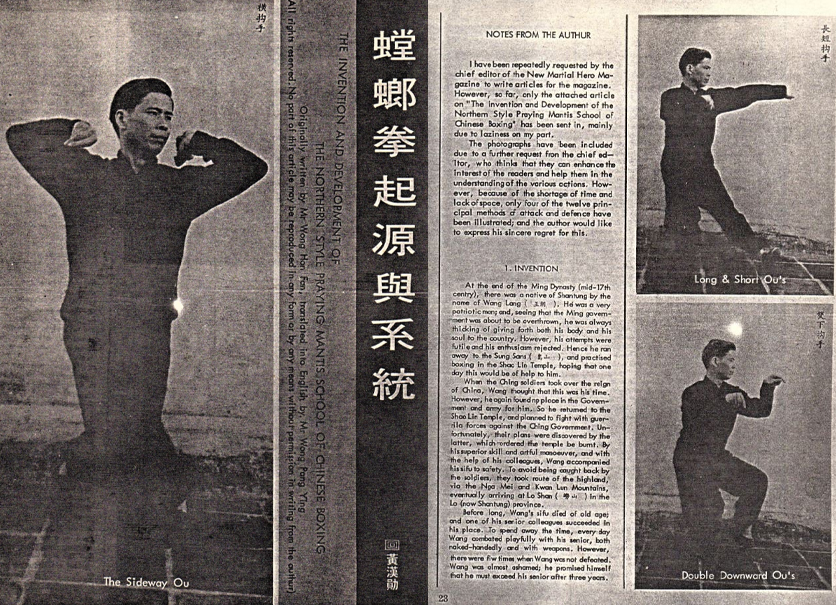
A english translation by Wong Pangying of the third chapter of Secrets of the Mantis Boxing Art, and published in New Martial Hero Magazine.
At the end of the Ming Dynasty (1368-1644), there was a native of Shandong by the name of WANG Lang. He was a very patriotic man; and, seeing that the Ming government was about to be overthrown, he was always thinking of offering his body and soul to save the country. However, his attempts were futile and his enthusiasm rejected. Hence he ran away to Song Shan, and practised martial art in the Shaolin Temple, hoping that one day this would be of help to the country.
When the Qing army took over the reign of China (1644), Wang thought that this was his time. However, he again found no place in the Ming-resistant army for him. So he returned to the Shaolin temple, and planned to fight with guerrilla forces against the Qing government. Unfortunately, their plans were discovered by the later, which ordered the temple be burnt. By the help of his colleagues, Wang accompanied his sifu to safety. To avoid being caught back by the soldiers, they took route to the highland and eventually arrived at Lao Shan in the Shandong province.
Before long, Wang’s sifu passed away of old age; and one of Wang’s senior succeeded in his place. To spend away the time, every day Wang combated playfully with his senior, both naked-handedly and with weapons. However, there were few times when Wang was not defeated. Wang was almost ashamed; he promised himself that he must excel his senior after three years.
Three years passed easily. Well prepared, Wang combated again with his senior. He lost again. Now Wang was so ashamed that he almost thought of killing himself! Then, one day Wang’s senior told him that he was leaving to tour around for a while, and would not be back until after three years. He also bid Wang to practice martial art continually, and he expected great advances in wang’s skills when he returns.

Click on image to see the full page
One hot day during his senior’s leave, Wang found it boring to stay in his chamber. So he took his sword and some books and sought resort in the woods. Just as he has cooled himself down and was beginning to turn the pages of a book, he heard some hissing sound. The sounds even seemed desperate. Wang looked up and found, high in a tree, a praying mantis and a grasshopper fighting to the death. By means of its strong arms and chisel-like claws, the former attacked the latter ruthlessly. Very soon, the grasshopper fell dead.
An idea came into Wang’s mind. The praying mantis played artfully during its kill. He attacked and retreated at the right moments; using long distance blows and close crushes correctly; and grasped and released methodically. Does this not resemble the skills one use in martial art? So, he climbed up the tree and took the praying mantis back to the temple; and henceforth provoked him every day with a piece of straw, watching carefully the reactions of the praying mantis.
Being an intelligent man, Wang discovered very soon that the praying mantis made use of twelve principal methods for attack and defense, namely, gōu, lǒu, cǎi, guà, diāo-jìn, diāo-dǎ, zhān, nián, tiē, kào. He took into reference the steps of the monkey. He further took the best points out of seventeen other schools of Chinese martial art at that time, and merged them into one unique, concise school, now known as the Northern Style Praying Mantis school.
When Wang’s senior returned after the three years, he combated again with Wang. Not knowing Wang’s great improvement in his skill, he was thrown yards away during the combat. Shocked, he asked Wang for the story behind. Wang told him all that happened. After that, they practiced with each other on the newly invented skill, refining the art to superior level.
This is how the Northern Style Mantis School of Chinese boxing was invented.