
A Discussion of Hard & Soft, Empty & Full.
The Mantis Methods Of Fighting – By Wong Hon Fan 黃漢勛
Translated from – Secrets of the Mantis Boxing Art 3rd edition – published Mar, 1955
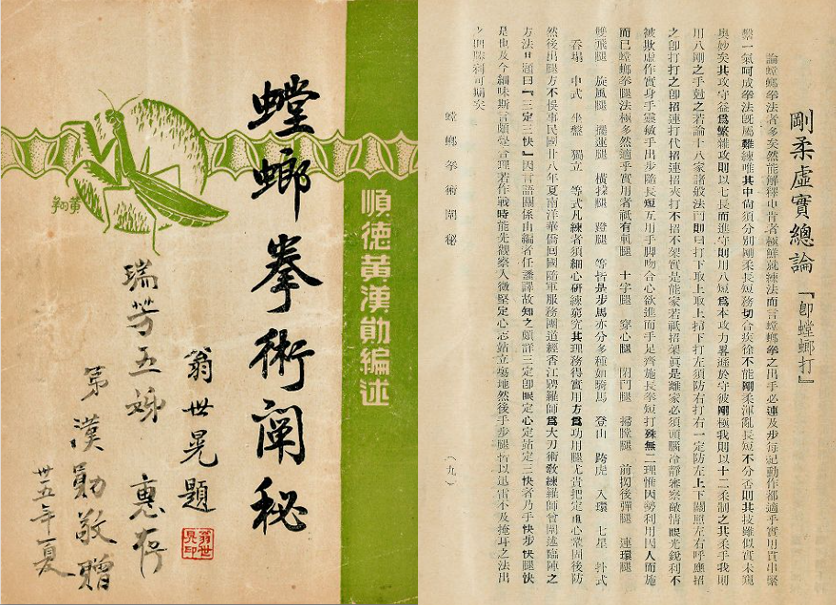
剛柔虛實總論 (卽螳螂打)
論螳螂拳法者多矣,然能解釋中肯者極鮮,就練法而言,螳螂拳之出手,必連及步,每紀動作,都適乎實用,貫串緊繫,一氣呵成,拳法旣屬難練,唯其中尚須分別剛柔,長短,務切合疾徐,不能剛柔渾亂,長短不分,否則其技雖似,實未窺奧妙矣,其攻守益為繁雜,攻則以七長,而進守則用八短,為本攻力畧遜於守,彼剛極我則以十二柔制之,其柔手我則用八剛之手法尅之,若論十八家謂般法門,則曰:打下取上,取上削下,打左須防右,打右一定防左,上下關照,左右呼應,招之卽打,打之卽招,連打代招,連招夾打,不招不架,實是能家,若祗招架,眞是離家,必須頭腦冷靜,審察敵情眼光銳利,不被欺虛作實,身手靈敏,手出步隨,長短互用,手脚吻合,心欲進,而手足齊施,長拳短打,殊無二理,惟因勢利用,因人而施而已!螳螂拳腿法極多,然適乎實用者,祗有軋腿,十字腿,穿心腿,閉門腿,掃膛腿,前抅後彈腿,連環腿,雙飛腿,旋風腿,擺蓮腿,橫掃腿,蹬腿等皆是,步馬亦分多種,如騎馬,登山,跨虎,入環,七星,扑式,吞塌,中式,坐盤,獨立等式,凡練者須細心研練,窮究其理,務得實用,方為功用,腿尤貴把定心,鞏固後防,然後出腿方不悞事,民國廿八年夏,南洋華僑囘國隨軍服務團,道經香江聘羅師。為大刀術敎練,羅師曾闡述臨陣之方法,其題曰『三定三快』,因言語關係由編者任譒譯,故知之頗詳,三定卽眼定,心定,站定,三快者,乃手快,步快,腿快是也,及今細味斯言,頗覺合理,若作戰時,能先觀察入微,堅定心志,站立塲地,然後手步腿皆以迅雷不及掩耳之法出之,則勝利可期矣。
Many people speak about Praying Mantis Boxing, yet those who can explain it accurately and to the point are extremely rare. When discussing training methods, every hand technique in Mantis Boxing must be linked with footwork; every movement must be suited to practical use, tightly connected throughout, and completed in one continuous flow.
Because this boxing method is difficult to train, one must clearly distinguish between hard and soft, long and short, and properly match speed and timing. Hard and soft must not be confused, nor long and short left indistinct; otherwise, even if the techniques appear correct, the true subtleties have not been grasped.
Its methods of attack and defense are increasingly complex: in attack it emphasizes the Seven Long methods, while in advancing defense it employs the Eight Short methods. By nature, its attacking force is slightly inferior to its defensive strength. When the opponent uses extreme hardness, I control it with the Twelve Soft methods; when the opponent uses soft hands, I counter with the Eight Hard methods.
As for the general principles recognized among the Eighteen Elders, they state:
Strike low to take high, take high to cut low.
When attacking the left, one must guard the right and when attacking the right, one must guard the left.
Upper and lower must support one another, left and right must respond to each other.
Defense immediately becomes attack, and attack immediately becomes defense.
Continuous striking replaces blocking, continuous blocking contains striking.
To need neither block nor parry is true skill, while relying only on blocking and parrying is to stray from the art.
One must maintain a calm mind, carefully observe the enemy with sharp eyes, and not be deceived by false displays made to appear real. The body and hands must be agile, the hand moving as the step follows; long and short methods must be used together, hands and feet must be perfectly coordinated. When the intent advances, the hands and feet act together. Long boxing and short striking follow the same principle, differing only in adapting to circumstances and applying according to the opponent.
Praying Mantis Boxing contains many kicking methods, yet those truly suited to practical use include the pressing leg, cross leg, heart-piercing kick, closing-the-gate kick, sweeping kick, front hooking and rear snapping kick, linked kicks, double flying kicks, whirlwind kick, lotus swing kick, horizontal sweeping kick, and stamping kick. There are also many types of stances and footwork, such as the riding-horse stance, mountain-climbing stance, tiger-straddling stance, entering-the-ring stance, Seven Star stance, pouncing stance, swallowing-and-collapsing stance, central stance, seated coiled stance, and single-leg stance.
All practitioners must train with care, thoroughly investigate the principles, and strive for practical effectiveness, for only then does the art have true function. In kicking methods especially, it is essential to stabilize the center and secure the rear defense; only then can kicks be issued without error.
In the summer of the twenty-eighth year of the Republic, when the Overseas Chinese Returning-Home Military Service Corps passed through Hong Kong and engaged Master Luo as a sabre instructor, he once explained methods for battlefield engagement under the title “Three Stabilizations and Three Speeds.” Because of language differences, these explanations were translated by the editor, and thus recorded in detail.
The Three Stabilizations are:
Steady eyes, steady mind, and steady stance.
The Three Speeds are:
Fast hands, fast steps, and fast legs.
Upon reflecting carefully on these words today, they are found to be entirely reasonable: if, in combat, one can first observe with precision, firmly settle the mind, and establish position, then release hands, steps, and legs with the suddenness of thunder and lightning, victory may be confidently expected.