
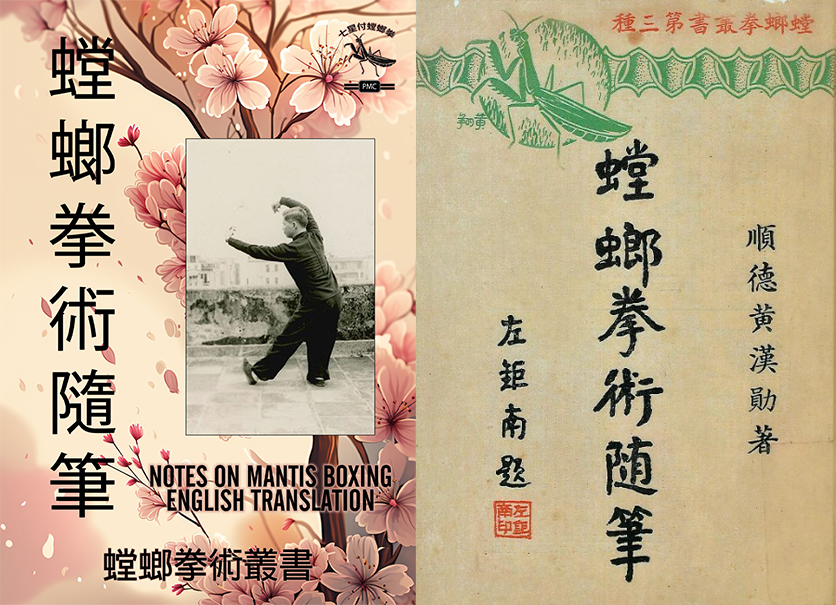
Notes on the Mantis Boxing Art 螳螂拳術隨筆
English translation of the 1st edition – published Jun 29, 1951 by Wong Honfan – 黃漢勛
Translated 2023 by @mantisboxer416
Preface
In order to elucidate the principles of martial arts, the students of the Jingwu Martial Arts Department in Keqiu have set up a “Weekly Paper Poster.” They have invited me to contribute an article for each issue. I find that my thoughts are better expressed in writing than in oral presentation, so far I have accumulated several dozen articles over many issues. As time passed, many students have forgotten them and have asked me to publish them as a book for permanent reference. Initially, I did not intend to publish them, hence I felt they were disorderly and lacked coherence. Additionally, when I wrote them, I often had no clear direction, and with my busy schedule, I had no time to revise them. I fear that upon publication, there may be repetitions or omissions, which would be subject to criticism. However, in advocating for national heritage and promoting Praying Mantis boxing skills, there is no time to consider these concerns.
Since the recovery of Hong Kong, I have published books on Praying Mantis boxing skills, this being the third. With my limited abilities, although I desire to promote them widely, I am ashamed that I cannot do more. I deeply hope that my colleagues at home and abroad will not consider me incompetent. Let us vigorously promote the spirit of Jingwu, strengthen our country, and contribute to the prosperity of our nation.
Written by Huang Hanxun in the mid-summer of the Xin Mao year at the Jingwu in Hong Kong.
Three styles originally belonged to the same family
The Praying Mantis martial art has been created for over three hundred years, spanning seven generations. However, there are often criticisms from outsiders claiming that Praying Mantis Boxing is divided into three schools. Those who do not understand this are prone to doubt, and there is no way to judge the true difference. Those who exploit the reputation of Praying Mantis often falsely claim to be authentic. Who then would be willing to admit otherwise? It was only after Master Luo and Master Yang Weixin took up teaching positions at the Shanghai Central and First Jingwu Associations that people in the South began to know about Praying Mantis boxing. This fact cannot be easily changed, as the art has been passed down to this day by disciples of either the Luo or Yang families. Both Luo and Yang were disciples of Fan Gong, and each set of boxing techniques can fully demonstrate their effectiveness, such as the commonly seen techniques of counter-disruption. Otherwise, impostors would have nowhere to hide. Could those who deceive the world with their skills escape this scrutiny? Recently, shameless individuals have shamelessly combined different techniques and passed them off as authentic. Initially, I just laughed it off, but these people have openly performed in public, trying to deceive with falsehoods. Their intentions are unpredictable. Therefore, I outline these points for your consideration.
Regarding the so-called three schools of Guang Ban, Plum Blossom, and Seven Stars, they are essentially the same, originating from Wang Taizu, who intentionally taught three disciples separately, passing on the techniques of the upper, middle, and lower routes based on their physique. When they reached a certain level, they compared their skills, and the results were evenly matched. This led later generations to mistakenly believe in the existence of three schools.
Reading and practicing martial arts
A reader is someone who is immersed in books, with their hand never leaving the scroll! They tirelessly search and ponder, their voice of inquiry never ceasing. A martial artist throws punches and kicks vigorously, with a majestic demeanor! If viewed superficially, how can they be grouped together for discussion? However, there is a rationale behind this.
A beginner in reading focuses on recognizing characters, while a beginner in martial arts focuses on recognizing the forms. But why bother with questions or recognition in martial arts?
One might ask, if a martial arts student does not inquire, how can they know the names, and without recognition, how can they remember? If it’s about practicing punches, palm strikes, and footwork, it aligns with the purpose of both beginning to read and learning martial arts. When advancing further, readers need to analyze the tones of characters—level, rising, entering—to lay the foundation for writing. Similarly, when martial artists have mastered their stances and steps, they need techniques for hands, eyes, and mind to complement each other. Writing a poem in seven steps, leaning on a horse, shows the agility and talent of ancient scholars.
However, the application of martial arts techniques often involves risking one’s life. In the exchange of punches and kicks, and when both blades and spears are raised, life and death, victory and defeat, can be seen in an instant. This is far from the poetry-writing on horseback, which can only be hoped for in an unlikely scenario.
Therefore, martial artists, in addition to regular practice, must also deeply study the tactics against the enemy. Otherwise, when faced with combat, the chances of crumbling with a single blow are rare.
Ordinary people practicing boxing merely punch into the air. Those with a better understanding of boxing principles imagine an opponent with every punch and kick, ensuring that each strike does not waste energy. With long-term practice, when it comes time to strike, their mind and hand naturally synchronize, as if painting the perfect picture.
Next, among fellow students, select an ideal partner for sparring. Practice with varying scenarios, turning imagination into reality. However, the partner must understand the true meaning of the techniques, not just possess excellent skills. Many people have a competitive mentality, and if they are hit by their partner, they hold grudges, which is a major problem in the martial arts world. I hope all students pay attention to this, as it can eliminate accumulated problems in our country’s martial arts and lead to prosperity.
Three Speeds and Three Timings
Our late master often reminded us that, in addition to striking first for the eyes, our school of martial arts also has the principles of Three Speeds and Three Timings, which are not easy to grasp for combat. I have been studying these principles for over twenty years, and although I dare not claim to fully understand their subtleties, I have some knowledge. I will now explain Three Speeds and Three Timings, or Three Fast and Three Slow, for those practicing our school of martial arts.
Three Speeds require Three Timings to support their practical application. If one only knows about Three Speeds but not Three Timings, their efforts will be doubled but the results halved.
The Three Speeds are: Hand Speed, Foot Speed, and Leg Speed. Martial artists often say to strike fast against slow and to control movement with stillness, which is similar to the concepts of emptiness and fullness, where fullness becomes emptiness, and vice versa, making it difficult to discern which is more enjoyable.
In a battle between two sides, relying solely on speed to control the enemy requires us to be faster than the enemy. Only then can we achieve great success. If the enemy is faster, then we are constantly under their control, and the chances of winning are slim. Hence, the importance of Three Timings.
Hand Speed makes it difficult for the enemy to defend. Foot Speed allows for swift movement between advancing and retreating, as quick as a shooting star. Leg Speed makes it difficult for the enemy to avoid, even if they know our leg is moving. Thus, the Three Speeds are achieved.
What are the Three Timings? They are: Mind Timing, Eye Timing, and Striking Timing. The mind is the master of a person; what the mind thinks is reflected externally. When there is a thought, the eyes must first look, which is a common principle. In the midst of combat, the eyes see, the mind follows, and then the hands and feet strike. If we can develop the Three Speeds and combine them with Mind Timing, Eye Timing, and Striking Timing, making the whole body act as one, ensuring that the hands are fast and reach, the steps are fast and timely, and the legs are fast and reach their target, we can avoid aimless attacks and ensure that every strike is purposeful. Thus, the explanation of Three Speeds and Three Timings is not in vain.
Three Steadies and Three Slows
What are the Three Steadies? When a deer is startled on the left, its eyes do not blink; amidst a flurry of swords and knives, it remains unaffected, which is Eye Steady. When suddenly faced with danger, one remains calm; surrounded by attacks from all sides, one remains fearless, which is Heart Steady. Amidst the tumult of attacks from all directions, one remains unmoved, which is Stand Steady.
The boxing classics say, “Only movement can control stillness,” and “Stillness can overcome movement.” This point, along with the concepts of emptiness and fullness, holds profound wisdom. The Great Learning states, “Only with movement can there be stillness, and only with stillness can there be peace of mind and rationality, with the mind free from distractions.” This is the way of application.
Movement leaves traces that can be followed and practiced along a path. Stillness, on the other hand, requires years of experience to accumulate before it can be explored and understood. It can only be understood through experience and cannot be easily transmitted through words.
Therefore, when first learning boxing, one should start with the Three Slows to easily grasp the main principles. Based on my experience of over twenty years, I have observed that many beginners tend to learn too much but practice too little. They are not concerned with correct posture but rather seek to learn several sets of techniques to check them off the list. Teachers who are lax in their teachings do not correct this, leading to a spread of this practice, which is regrettable for the future of martial arts.
If one can start with the Three Slows, although their martial arts skills may not be outstanding, they will not be ridiculous in the eyes of experts.
The boxing classics say, “Strike quickly but guard slowly,” which is one aspect of slowness. “Seek refinement, not quantity,” which is another aspect. Before learning boxing, when one first has the intention to learn, they should not blindly start learning. Instead, they should first seek out a style of boxing that suits their personality and find a teacher who can guide them well. Only then should they make the decision to practice, to avoid straying from the right path and becoming lost, which is a form of slow understanding.
If we can follow these Three Slows, develop the Three Steadies, achieve the Three Speeds, and master the Three Timings, then we will not fail to live up to our enthusiasm for learning boxing.
Health and Happiness
Considering that animals survive by relying on countless cells, human health and weakness also depend on the health of their cells. However, lifestyle also plays a significant role. Comparing the bodies of people from ancient and medieval times with those of today, there is a stark difference. The former worked from sunrise to sunset, living a life with regularity and simple thoughts, while the latter is surrounded by sensory indulgences, seeking novelty as entertainment all day long. Comparing the energy consumption and preservation between the two, especially for those living in bustling cities, the difference is profound. Consider the people of Hong Kong who live in cities.
Under good governance, the overall sanitation facilities and canal cleaning in cities are generally better than in rural areas. Despite active efforts to prevent and eradicate tuberculosis, the number of those afflicted with this terrifying disease continues to rise without end. Why is this? It is because life lacks regularity, and diet lacks discipline. People in rural areas do not understand the concept of hygiene. Their living conditions are comparable to living next to cow dung piles, competing with various pests for food. However, the prevalence of diseases is not as common as in urban areas. News of people suffering from chronic illnesses and resorting to suicide is occasionally seen. In a corner of Hong Kong, there are hundreds of public and private hospitals, yet there are still patients overflowing. Those who pay attention to social issues cannot help but be disheartened by this. Once a laborer falls ill and is bedridden, the family’s meals become uncertain, let alone medical treatment. Isn’t this waiting for death? After borrowing, selling, pawning, and mortgaging, one ends up dying. The suffering from illness is the greatest threat to human survival. If we wish to eliminate this demon of humanity, we can only do so by being strong and healthy. Is there a way to be healthy? Yes, exercise is the way. There are various ways to exercise, but one must consider economic, time, location, and material constraints. Besides martial arts, there is no other way. Training in martial arts is not limited by location, money, number of people, or material. If one wishes to develop a strong body to resist diseases and achieve happiness, martial arts are the way to go.
Seeking a teacher is difficult, and finding a student is even more difficult.
It is said that Confucius traveled through the snow to seek guidance from Master Cheng, Sun Bin visited King Hui three times but could not meet him, and Liu Bei visited Zhuge Liang three times at his thatched cottage before finally convincing him to come out of retirement. Seeking a teacher has always been difficult since ancient times. In the martial arts world, many are tainted by greed. With limited resources, can they meet their unlimited desires? Thus, unethical and immoral behavior is rampant. Are these teachers worthy of being called teachers?
Many people in the world lack the spirit of hard work and perseverance due to the pressures of their living environment. They hope to avoid hunger and cold with inferior skills. When asked about the source of their skills, they boast of being the secret disciple of a famous master. When asked about their expertise, they claim to be proficient in all eighteen weapons. They demand a high price for their teachings, causing students to bankrupt themselves. Seeking students is equally difficult. Many people nowadays lack the perseverance to learn a skill with no ultimate goal in mind. They learn for the sake of playing. They lack the dedication to delve deeply into a subject, and they often cause trouble by resorting to violence. Can students like these contribute to the advancement of martial arts? Chinese literature, music, painting, and martial arts are all part of our thousands of years of history and culture. However, the younger generation is not as capable as the previous one, leading to a decline in our cultural heritage. In contrast, European and American countries have made great strides in medicine and sports. This backwardness and advancement make it clear that we cannot rely on past achievements for future progress.
The Psychological Journey of Martial Arts Training
Due to the legendary figures described in martial arts novels, which are captivating and mythical, people have a mysterious impression of martial artists. Additionally, many martial arts masters intentionally create an aura of mystery, resembling the characters in folk tales. Those who have not yet practiced martial arts first feel this sensation and then develop a sense of admiration, thus making the decision to train in martial arts. When one begins practicing martial arts, there is an infinite sense of hope and excitement. However, upon observing advanced classmates perform dazzling martial arts moves with weapons, one might regret not being able to learn them immediately. Despite having once mustered the mental and physical energy to start, they may now feel a different sensation in their mind.
If one can remain calm during this period, they can smoothly enter the second stage. Otherwise, with one setback, their initial goal of learning a skill may be forfeited.
Afterwards, one may become restless, often falling into the trap of superficial learning, leading to a state of confusion. Some may become overconfident, thinking themselves invincible, which is truly a great misconception.
After three or four years, due to the monotony of daily practice and the solitary lifestyle, their mindset may change. People often succumb to the common human tendency to seek novelty, which can be frustrating. Progress may not be apparent, and they may even feel they are regressing. However, is it logical to think that after practicing diligently day and night, one would regress? It is merely a trick of the mind.
Around six or seven years into training, as one gradually approaches mastery, the future appears bright, like reaching the other shore.
It is a pity that during the intense phase, before reaching mastery, one must endure many hardships and be influenced by society. Only then can they achieve true mastery and reach the pinnacle. At that time, they may appear weak to others, but they are actually displaying patience and tolerance.
This progress was made possible by the great efforts of many.
In the past two or three years, the government authorities have begun to pay attention to the activities of the Jingwu Association. They realized that without strong people and a strong nation, they could not save themselves from peril. Therefore, they commissioned Zhang Jiangshi to establish the National Martial Arts Hall at the foot of Zijin Mountain in Nanjing. This was the first time the government directly promoted martial arts in this way. Starting from the 7th National Games, martial arts became an official event, and in the following years, Zhang and the key members of Jingwu led their athletes on a tour of Southeast Asia, which was the first time they had showcased their skills overseas. The martial arts community could be said to have regained its pride at this point. However, the organization of these two initiatives was only aimed at urban areas, and had not yet spread to the general rural population. There were still many martial arts practitioners who transmitted their skills in a haphazard manner, and lion dance performers extorted money from merchants. The organized forces were involved in all sorts of deceitful activities, which were widely known. Those who were concerned about this couldn’t help but feel disheartened.
Developing Martial Arts Instructors
In the history of Chinese education, since the establishment of teacher training schools, a new chapter has been opened. Unlike the past, when apprenticeship was a major problem, the practice of martial arts has remained unchanged for thousands of years. There have been some changes, with the Jingwu Association being the pioneer. Since Huo Yuanjia founded Jingwu, the ideology of Jingwu has greatly improved the martial arts community. The planners at that time, such as Lu Jun Canchang, Chen Jun Gongzhe, Yao Jun Xibo, and Chen Jun Tiesheng, were all scholars who were well-versed in both Eastern and Western cultures. They harbored the grand ambition of improving Chinese martial arts. Notably, they eliminated prejudices to promote the public good, established teacher training classes, which required two years of basic training, four years of intermediate training, and six years of advanced training before joining. Although the period was short, they achieved excellent results. After the training period, the outstanding individuals were assigned to serve in various branch associations. They were closely supervised and moved around every few months or a year to gain more experience. From this, one can understand the efforts of the predecessors. After 1921, this important work was suspended and has not resumed since. Continuing the work of Jingwu and contributing to the great cause of martial arts in the future will be an arduous task.
It is rare to find someone who has devoted seven or eight years to martial arts, and even rarer to find someone who has diligently followed the rules and regulations and focused on practicing for seven or eight years. The unification of understanding and teaching methods in terms of techniques is extremely difficult. It is difficult to guide and inspire students to increase their enthusiasm through tangible and intangible means. It is also difficult to have a unified understanding of teaching and the establishment of venues. If asked about the (teacher’s transmission), one may not have a definite answer. Today, with the continuous decline of martial arts, there is a lack of strong teaching staff. The fate of martial arts in the future will be left to heaven! When thinking about this, one can’t help but sigh deeply.
There is No Second to Martial Arts
China’s historical arts such as traditional painting, martial arts, and traditional medicine require a considerable foundation in literary thought. However, those who practice medicine or painting must have a certain literary thought as their foundation. However, those who practice martial arts are often seen as “martial bulls” by the literati, treated like dogs or chickens. How many martial artists can be as elegant as Guan Tianzi, holding a candle to the history of the Spring and Autumn Period, or like Yue Feizi, showing both literary and martial talents, killing enemies while spreading straw to sleep on? From ancient times to the present, few people can compare to the sages of the past. On the day of the triumphant return of the General of the Great Tree, he stood alone under the big tree, not taking credit for defending the country’s soldiers’ lives and deaths. Compared to today, where people often boast about their abilities and seek victory, the gap is as vast as the sky. When we read history to this point, we can’t help but sigh deeply.
Looking at the development of sports in foreign countries over the past century, every athlete, in addition to possessing skills, must also pay attention to learning and cultivate morality. If one is lacking, they will not be respected. It is known that in the past, those who used strength to dominate were considered tyrants, and those who moved people with virtue were considered heroes. This is not deceptive. Under the support of scientific development, all aspects of foreign countries are constantly advancing. The summary is as follows:
Starting with medicine, Western medicine, under government incentives, conducts daily research through dissection and experiments, leading to frequent inventions. Our Chinese medicine, on the other hand, is still seeking the main treatment as it did more than two thousand years ago. Even if it can compare with the medical sage Zhang Zhongjing, it is still based on the theories of the 20th century. Moreover, people in the medical field never dare to boast about being superior to their predecessors. They do not know how to measure progress. In sports, England’s football and America’s basketball are known as kingdoms, but many championships have been won by other countries. It can be seen that under scientific management, they strive for excellence. Football has a history of more than 20 years and can be called a first-class fan. The tactics and strategies of basketball and football are constantly changing and improving. Unlike Chinese martial arts, which are still based on ancient practices, they do not seek understanding, do not study, not only have made no progress but also have regressed from generation to generation. The reason lies in the belief that there is no second to martial arts. Martial artists are arrogant and consider themselves unbeatable. If you ask a martial artist, “Are you willing to rank ninth among martial artists?” I believe no one will admit it. But in his heart, he also knows that he is not even close to being the ninth. This accumulation of martial arts’ problems, if everyone continues to hold onto this mindset, martial arts will be eliminated by the times and despised by the people, regarded as a tool for entertaining those who seek money. Can it still be called martial arts?
To Cherish Time and Speak to Fellow Practitioners
“Wu Mu Man Jiang Hong” (Don’t wait until the youth’s head turns white! It’s empty and sad). This is not an empty saying. Those of us who practice martial arts must seize the time, or success will slip away in an instant.
This feeling is based on my personal experience over more than twenty years. When I first started practicing martial arts, no matter how tired I was, after a night’s sleep, all fatigue would disappear. After practicing a series of ten sets or using special heavy equipment, although my limbs felt sore, after walking around the martial arts field a few times, my strength would immediately recover, and I could continue practicing. This is truly a sign of abundant vitality, as the saying goes, “strength begets strength.” Is it still possible to achieve this today? Even if I reluctantly say so, it is not a heartfelt statement. Young people have no worries and do not know what hardship is. Everything is easy to learn when one is young. But when one reaches middle age and worries about everything, can middle-aged people achieve this? Doing the hard work of standing on a stake of life and death, inserting iron sand, and kicking, for those who are young and strong, the more they practice, the more fun it becomes. However, once they stop, they feel uncomfortable all over. Can middle-aged people have this kind of perseverance? Doing a horse stance, doing front kicks, practicing skin conditioning for three weeks, even for those beyond middle age, it is still not easy to achieve this. I advise my fellow practitioners who are under thirty to cherish their time, enter the realm of health early, and they will enjoy endless happiness in their lives. Do not let time slip away, for it will be too late to pursue the path of health and happiness in middle age.
Looking back on the past, I sincerely advise my fellow practitioners not to waste this precious time.
The Annual Requirements for Martial Artists
Chest out, belly protruding, pretending to be powerful, spitting while speaking, often clenching fists and flexing arms – these are all behaviors of martial artists seen in the streets. Those who understand the current situation will follow their preferences, and those who seek advantages will also be pleased with what they like. They often boast about being disciples of certain martial arts masters, and these martial artists proudly respond to such claims. They often appear arrogant, and those who are timid and humble tend to avoid them, fearing they may provoke their anger and suffer unjust humiliation. Those who recognize this behavior also avoid them, tired of their crude attitude. Only those who depend on their strength to make a living treat them like gods.
Martial artists are merely instructors in martial arts skills. Why do they behave so rudely? It is because of the accumulated habits that no one can self-examine and reform their bad habits. Don’t they know that the more honest, kind, and respectful one is, the more respected they will be? Must one resort to intimidation to gain respect? Being an instructor is not just about passing on techniques; it is also about leading by example, regulating oneself and others. Only then can the martial arts culture of thousands of years be maintained without being replaced. Otherwise, even if one has amazing skills, without a moral perspective, can this method be passed on to future generations?
The renowned figures in the martial arts world are not solely relying on their outstanding martial arts skills. Their fame is actually based on morality. The late master Sun Lutang of Baguazhang started practicing martial arts at the age of ten and continued until he was over eighty years old, yet he never dared to consider himself a master. His history and reputation in the Chinese martial arts world can be called a grandmaster of his generation. Such humility, like Lu Weichang, the mainstay of the Jingwu Association, has been wearing a student uniform for over thirty years. If the comrades in the Jingwu Association do not know the facts, let alone us young people? A great mind appears foolish, great courage appears cowardly. In the past, what a gentleman did was not enough to oppose the world. Although I do not seek to be worshipped by future generations, I must wash away the unsightly name of being a martial bull for now.
The Minimum Etiquette for Martial Arts Practitioners Towards Instructors
Master Yue said that General Wu Mu studied martial arts under Teacher Zhou Tong, treating him as a father. After Teacher Zhou passed away, General Wu Mu abandoned fame and fortune and lived by the grave for three years in observance of etiquette. Sun Bin paid three visits to King Wei but was not granted an audience. It is known that in the past, it was difficult to learn from a master, as seen in these historical anecdotes. If such incidents were to occur today, people would laugh at it as a remnant of feudalism. However, today’s attitude towards instructors is simply comparable to colleagues or subordinates, which is not without complaint but is based on genuine feelings. The following examples are provided to prove the validity of my statement: in academic discussions, it is reasonable to present arguments for progress. However, when retreat is threatened and instructors are pressured to conform to the students’ opinions, or when students demand to be taught a certain academic topic, or even request to practice together with the instructor to show a semblance of humility in learning, but in reality, it is like forcing the instructor and themselves to undergo labor. If dozens or even more scholars make such requests, won’t the instructors be forced to deal with them in a mechanical way? And what about those who come after? If this trend continues, the instructors will be exhausted to death.
If one can speak from a truly selfless position, there must be a certain teaching procedure, and one must never comply with the students’ demands for specific teaching points. Otherwise, the relationship between teaching and learning becomes no different from a transaction. Only by seeking mutual benefits can we progress. Are there instructors who are dedicated to serving students? Their academic and moral evaluations are worth considering.
The Martial Arts World is Facing a Great Crisis
The heroic spirit of bravery, fierceness, and victory, which was once valued, is gradually losing its value in the bright era of the 20th century. Those who are obsessed with the past feudal system will find the future of martial arts unimaginable. In rural areas, disputes sometimes escalate to the point where people reach for their waist to grab weapons, and martial arts seem to have lost their status. In urban areas, which are densely populated, fighting is illegal, and no good person dares to act unlawfully. In the past, it was often said that one must be proficient in all 18 martial arts skills, but today, people would laugh at such outdated ideas. The Great Wall of China, which was once a defense against invaders, is now seen as a waste of money. As times change, martial artists are still not eager to catch up. They should improve their methods to promote physical fitness and health, making it a widespread activity among the people, so that those who have always disliked martial arts can develop a genuine appreciation for it. The training methods should also be simplified to make them more accessible. If one can become proficient after three to five years of practice, it should be sufficient to deal with bullies and then some. It is shameful to be brave for no reason. If future learners can be guided onto the right path, without wasting their time on old-fashioned ideas, and if they can find effective ways after ten or eight years, there is still a glimmer of hope for the future of martial arts. Otherwise, martial arts will become a thing of the past. I have followed the banner of the Jingwu Association for more than twenty years, witnessing such scenes. How can I not lament the future of martial arts?
Criticism of Those Who Speak Nonsense
Humans are animals with sensitivity and a desire for leadership. If we look at the struggles for politics and ideologies throughout history, where people did not hesitate to kill each other to pursue their own interests, it is quite admirable. In the art world, everyone tends to praise their own work or skills, as the saying goes, “People praise their own articles and want others to praise them too.” However, although people may think this way, they do not often boast about it, for fear of being ridiculed.
However, in the martial arts world, self-praise is not uncommon. When I first learned martial arts, I met a highly praised martial artist who claimed to have the power of five hundred catties (Chinese weight unit) in his bridge. At that time, being young and ignorant, I boldly asked, “Is this strength useful? I don’t even have the strength of a hundred catties. Can you teach me something new?” He arrogantly replied, “I was able to do this when I was young. I’m old now, so I can’t do it anymore.” His tone implied that he was irritated by my questioning and he sarcastically asked if I was like him, eating porridge for dinner. He dared me to compete with him. My older brother was present and noticed his tone and expression, knowing that he was getting angry. He signaled to me to leave. I left feeling annoyed. Later, I asked my master if there was anyone in the world who had the strength of five hundred catties. My master said it was just an exaggeration. Reflecting on it now, I realize the truth in my master’s words. Nowadays, many martial artists make exaggerated claims, saying they can kill with a single finger or paralyze with a touch, skills that were indeed practiced in the past but have not been widely taught since the destruction of the Shaolin Temple. However, young people with limited knowledge are easily deceived by these absurd claims, which are actually very childish. One can find such claims in cheap novels and comics.
As the saying goes, “A musk deer has a natural fragrance, there is no need to spread it with the east wind.” This can be a true reflection of the martial arts world. One’s achievements will reveal the true level of their learning. Streetwise tactics are not enough to deceive people. I have seen many great martial artists today, and they are all humble and polite. One must understand that humility brings benefits, and excessive boasting leads to loss. This is not an empty talk. In today’s world, why bother boasting?
Emperor Taizu of the Song Dynasty used to travel around the country to seek advice from wise men and said, “There are always those stronger than the strong.” Even with his martial prowess, he still spoke humbly. This shows how far modern people have strayed from the ways of the ancients. I hope my fellow practitioners will take this as a warning, so that our names can be preserved, martial arts can flourish, and we can inspire the weak and strengthen our nation, making us stand tall in the world.
Those who practice martial arts should not be coldly ridiculed for their understanding! The sole purpose of our martial arts practice is to seek true artistry, with the principle of promoting health as the foundation. Those who seek only fame and glory are no better than stage clowns! For example, a poorly dressed young man may wear a stylish European suit and shiny leather shoes, but he may not have a penny to his name. On the other hand, a wealthy tycoon may not have such “equipment.” If one truly understands this principle, why flaunt martial arts, which were once used to defend the nation? Therefore, all comrades in the martial arts world with patriotic ideals should raise their vigilance, discern the truth from falsehood, and not be deceived by the defeated, so that there is still a glimmer of hope for the future of martial arts. Otherwise, a glorious page in history will be lost forever, and thinking of this, how can one not sigh with regret!
Are There All-Around Martial Arts Masters?
Heaven has given people varying degrees of intelligence, some with natural talent and others not. There are many who claim to excel in everything, from poetry, painting, calligraphy, and music to medicine, martial arts, and more. But let me give an example to demonstrate their self-deception. It is said that a truly intelligent person can become proficient in writing after three years and excel in poetry after five years. While the study of painting and calligraphy may seem like minor skills, they are not to be underestimated. The skills of playing musical instruments and chess may be considered games, but are there not a few who excel in them? Hua Tuo, a renowned physician in the Han Dynasty, was called a medical saint. His medical teachings were extensive and profound, not something that ordinary people could fully comprehend. As for the techniques of bone-setting and muscle strengthening, although there are models and references, can one truly grasp them without long-term clinical practice? Extraordinary diseases, strange symptoms, unheard-of and unseen, can one deal with them based solely on what they have learned? As for martial arts, it is a bottomless abyss. It is said, “Train your waist and legs for three years, and then you can start punching after five years.” Just focusing on punching and kicking is already extraordinary, not to mention the deeper aspects of internal energy! It is said that it takes a hundred days to train with a knife, a thousand days with a spear, and ten thousand days with a sword. Only after arduous practice for ten or eight years can one achieve success. I have immersed myself in martial arts for more than twenty years, and I consider myself to have achieved nothing extraordinary, just a basic understanding. I can teach beginners, but if I were to face a real battle, I would have no confidence. I am truly foolish. There are many who, barely thirty years old, boast of being proficient in both literature and martial arts, and even excel in medicine. If we calculate based on mathematics, do they not have the foundation of learning before facing the world? However, in today’s world, only those who boast can be called successful. Is this the shortcut to success? Is it not? I hope the wise will seek the answer themselves.
Discussion on the Daily Life and Diet of Athletes
People only know that athletes are physically strong and do not need to worry about the details of their daily lives and diets. However, they do not realize that athletes are constantly training their bodies and minds, and their diets are an essential part of this.
The Six Organs and Bowels produce the cells on which their survival depends, promoting health. If one is not careful with their diet, it can hinder their progress or lead to illness. During exercise, the heart and stomach are in a state of intense expansion and contraction. If one does not rest properly after exercise and immediately consumes cold foods like ice cream or soda, the sudden stimulation during the circulation of hot blood can lead to unchanging conditions. Or if one consumes hot beverages like coffee or alcohol after extreme fatigue of the brain and heart, although there may be temporary excitement, prolonged consumption may damage the heart and nerves. During exercise, muscles must contract, and the skin must sweat. At this time, many young people often stand in the wind to cool their skin, seeking momentary comfort. This is a common sight, and from the transition from heat to cold, wind and cold enter, lurking in the body and spreading throughout, causing external illnesses. This is indeed a neglect by those who advocate sports, especially in the martial arts sector. Looking at foreign athletes, they always wrap themselves in thick towels after exercise to prevent wind and cold from invading. I remember when the Danish football team came to Hong Kong for a match, they always had people bring woolen blankets with them, and as soon as they rested, they covered themselves with blankets. This was a common sight, showing that the mighty Europeans were not as careful as the small Chinese! This proves that foreigners have common sense in sports. I am not praising foreigners, but using the idiom of “taking a stone from another mountain to attack one’s own achievements.” This is a good phenomenon of human evolution. If we are narrow-minded and arrogant, we will be self-righteous. I cannot help but worry about the future of sports in our country.
Selfish Artists
There is a saying, “If you plant flowers with intention but they do not bloom, if you plant willows without intention but they grow into shade.” From emperors to commoners, everyone has a skill or talent, and they all hope to pass it on to their children. Even the saints cannot escape this law. It is said, “People send their sons to win gold, I send my son to inherit a classic.” In this regard, my words are not wrong.
However, things will change when they reach their extremes. During the feudal era, many emperors used various despicable and ruthless means to maintain the evil custom of “the father passes his house and kingdom to his son.” Despite this, look at the history of our country. How many dynasties have been able to last a thousand years?
During the Ming Dynasty, our Guangdong pillar Liang Qichao served as a prime minister and was deeply involved in court affairs, becoming a powerful figure for a thousand years. How could his descendants not have high hopes for the future? But his son was not willing to go to extremes, which is another clear example of the law of unintended consequences.
Those who pass on their wealth to their grandchildren only create parasites in society, the “second generation” of the world. It is commonly said that wealth does not last for three generations, which is truly a sharp criticism. Passing on material wealth to descendants is already so difficult, so how can one curse the arts? Those who boast of their ancestral skills are prevalent in medicine and martial arts. I won’t go into the pros and cons of medicine, but as for martial arts, I believe there is absolutely no possibility of passing down from one generation to the next, because of personality and environmental issues. I dare to assert this. The founder of Jingwu, Huo Yuanjia, was famous for his martial arts, but he was only forty years old.
At that time, Master Zhejun of Dongge was still very young, and Master Huo was often away from home, so how could he teach his son day and night? This is one aspect of environmental issues. However, Dongge was still able to pass on the family’s techniques through uncles and older relatives, continuing his father’s aspirations. This is a unique environment that contributed to this. Throughout history, there have been many martial arts masters in the north and south, but those who can truly pass on their skills are as rare as phoenix feathers and unicorn horns.
As artists in a democratic era, we should not harbor feudal remnants in our minds. We should open up to the public what we have, select those who are outstanding, and pass on their skills to future generations for the historical preservation of our country and nation.
Look at the Eastern martial arts such as Judo and Western arts like boxing, ball games, fencing, Western painting, Western medicine, etc., all undergoing experiments, transformations, and research, striving to preserve their originality and develop for the future. In contrast, all aspects in our country are regressing. Thinking of this, I can’t help but lament for the five thousand years of art in our country.
Under the pen of novelists
When I was young, I loved reading martial arts novels. At that time, the most famous were the tales of chivalrous heroes, but upon closer examination, most of the content was fanciful. Although reading them did not bring improvement, it did no harm either. However, the variety of books available then was vast, reaching its peak, unlike anything in the past. If you look at the bookshelves, newsstands, and other places, they are filled with them. I no longer have the leisure to read as I used to, but occasionally, I flip through a page or two to get the gist. Many of them are about deceased martial arts masters, claiming to have defeated someone or the other, but the opponents are often lacking real names and origins, only satisfying the curiosity of the questioner. If the rough outline of a certain famous master’s life story has not stopped for more than ten years, consisting of millions of words, involving hundreds of battles, each one a victory, is this a fact? Think about it, if such a fact were true, then this famous master’s life would be nothing but fighting. Can he still be called a grandmaster? A master? Will there be a moment of peace in this world? Is this what it means to promote sports? To support national arts? It is better to say that it is scaring people’s hearts, damaging national arts, and giving a bad impression to the younger generation. If they do not learn national arts, that is one thing, but if they do, there is almost no hope that they will not harm society!
There are also descriptions of conflicts between certain factions, with one faction defeating another, vividly described as if it were a serious matter. These words are not worth considering now, but future generations will use their “masterpieces” as points of contention. This kind of thing has already happened to some extent, and there will be more in the future. I deeply regret this as a scholar who enjoys reading poetry and books, and I also worry about the future of the martial arts world. Provoking disputes with words and pens, more than just a nuisance, is also a root of disaster. We should not only think about future generations but also remember the difficulties faced by our predecessors in creating martial arts. Changing the direction of our pens and correcting our perspectives, without losing sight of the forefront of the martial arts world, is my sincere wish for all of us in the literary world.
The Traces of National Martial Arts
Previously, Master Luo mentioned that in Shandong and various northern provinces, about sixty to seventy years ago, there was a customary practice. If someone, let’s call him A, wanted to open a martial arts school in a certain place, he had to first visit and seek approval from the local martial arts masters. Only then could he establish his school; otherwise, he dared not open it publicly. This was actually a sign of lacking exceptional skill and merely trying to make a living in the martial arts world. Those who truly possessed advanced martial arts skills behaved in the opposite manner. They would first post notices with red labels on major streets and roads, announcing the opening date and time of their school. Upon the designated day, they would light red candles inside the school (the size of the candle would be used to judge the skill level, as a larger candle would bring more fame). Martial arts masters from near and far would come to the school to compete. This was called “testing the school.” Once the red candles burned out, the matches would end. If no martial arts master was defeated at that time, the newly established school would prosper extraordinarily. If it was the opposite, there would be no face to stand on among them.
According to Master Fan, when he opened his school back then, he used a giant red candle weighing about four catties (approximately 2 kg), and it remained undefeated from start to finish. Therefore, his reputation remained unblemished until death. This was an example in the north, but what about in Guangdong? According to Master Ao, they would learn from famous masters of the Guangdong school (he followed four of the Guangdong Tigers). After laying a foundation, their teachers encouraged them to go out and test their skills (meaning to fight at will) to see if their learning was successful. When they reached a certain level, if they wanted to establish a school in a certain place, they would fight with the local boxers. Otherwise, they could not become famous. At the end of the Qing Dynasty, in a corner of Guangzhou, when the lights were first lit, many people who had practiced boxing for several years used innocent citizens as targets for their experiments. This was a bad practice in the feudal era. Can it still exist in today’s new era? Those who follow suit can only be considered as historical remnants.
The Origin of Southern Boxing and Northern Kicking
When people talk about martial arts, they often mention Southern boxing and Northern kicking. Does this mean that Southern boxing does not use legs, while Northern boxing does not use fists? This is a ridiculous argument! In martial arts, it’s not just about using fists and legs, but also about coordinating the head, shoulders, elbows, knees, thighs, arms, palms, and fingers. How can there be a method that abandons this coordination? The origin of this saying is that the Guangdong and areas south of the mountains mainly focus on stable and solid punches, often neglecting the use of shoulders and elbows. This is to prevent being controlled by the enemy, which can easily lead to the breaking of the arm.
If even the use of fists requires such caution, then the use of legs should be even more cautious. Therefore, although there are over a hundred moves in each set of Southern boxing, there are only two or three leg techniques. This is why outsiders do not consider the legs to be the main focus and simply call it Southern boxing.
Northern boxing mainly emphasizes long punches and low stances, with kicks often reaching above the head. In each set of punches, leg techniques only account for about ten percent, but because they are often high, they attract the attention of outsiders. This is why they are called Northern kicking.
The name of the leg is therefore significant.
However, is kicking dangerous? If punching can be dangerous without proper technique, not to mention kicking? The method of kicking has hand protection and evasion at every turn. Even if the enemy tries to control my legs, I can calmly evade. If this is the case, what danger is there to speak of?
Legs are longer than hands, and leg strength is stronger than hand strength. With such uniqueness, why should we abandon length for shortness and lightness for use? If you keep a sense of danger, why bother competing with others in terms of length of time? As the ancient saying goes, “The soldier who advances is in danger, but the soldier who retreats is in safety.” Am I brave enough to harm others? Can I escape the law? If I am injured by the enemy, I will suffer the pain first.
In conclusion, in this 20th century, I strengthen my body to fight against diseases, to establish a lifelong state of health and happiness. What do you think?
Many taboos in the world
“The brothers of the rivers and lakes are brave and fearless.” This saying is a common saying among those who roam the rivers and lakes, meaning that they are not afraid of heaven or earth. Those who roam the rivers and lakes are mostly single men, daring and adventurous. However, there are rules and etiquette in the rivers and lakes. For example, those who perform tricks must first declare that they are fake. If there is a flaw in the trick, the audience should not point it out in public, otherwise, they risk their lives. People in the rivers and lakes stay in mountains and lodges, as they have no fixed abode. When making medicine, they should not steal titles. If they are discovered, even friends and relatives will not escape being scolded. When demonstrating martial arts, they aim to impress the audience, called “blooming.” Any slight mistake is also to be avoided. Pointing fingers, whispering, and discussing in whispers are also to be avoided. When selling medicine or asking for money, they call it “ending.” It is especially taboo to set up another stall nearby. Often, incidents of fighting arise from this.
As for the sale of medicine, although they boast about the efficacy of their medicine, they never speak ill of others. If there are arrogant individuals who speak out, they will eventually be despised by their peers. Some even go so far as to determine life and death based on their connections. Many wild cranes outside the foreign ship are mostly thrown into the bowl. Before starting a business, they often use selling medicine as an excuse to deceive customers from overseas, using the strategy of throwing bricks to attract jade to lure customers who are just starting out. I once witnessed more than ten people mobilizing to deceive others of ten yuan. Even a slight delay in luggage was listed among the deceived. However, their skills were extremely superficial and inferior. Even if you can see through their tricks, you should keep silent, or else they will make up lies and beat you to silence you. People going out should be cautious, not greedy for treasures, not greedy for unjust profits, and not provoke unnecessary trouble. Then, even if the cheaters try to cheat you, you will not be harmed. Even if there are many bullies in front of you, you will not be humiliated. Be cautious and beware.
The difficulties of practicing Praying Mantis Fist
In Chinese martial arts, each style has its own difficulties, and there is no need for others to worry. They can seek their own challenges. As the saying goes, “Each sweeps the snow from his own doorsteps, but does not care about the frost on others’ roofs.” However, it is not easy to identify these difficulties. Regarding this book, where are the difficulties? I believe that most scholars are still in the dark. I remember when I first learned martial arts, there was a scholarly debate. However, among the hundreds of participants, no one pointed out the difficulties. This is a clear proof. Before I list the difficulties, everyone should first close their eyes and try to find them. Can you find the purpose? Let’s start with martial arts. Bupu, Double Elbows, Circle Strikes, Splitting Techniques, Hand Picks, and Molded Hands are all solid techniques that are connected in form. The difficulty lies in the inseparable relationship between form and shadow, each with its own hard and soft qualities. If one is lacking, the complete technique loses its effectiveness. This is one difficulty. Crushing, twisting, pulling, double slamming, and double tapping elbows are all techniques that are sealed before they are executed. Before striking, one must first neutralize the opponent’s attack, then execute one’s own technique. This requires precise timing. If not, the technique will fail. This is the second difficulty. Thrifty Hands, Hands, Grinding Hands, External Hanging Hands, Sticky Hands, and Black Tiger Linked Hearts are all techniques used in sparring. Their difficulty lies in their complexity. As two people advance and retreat, their hands and feet move continuously, their bodies turn with their steps, their steps follow their hands, and their movements are coordinated, which is both thrilling and challenging. This is the third difficulty. Praying Mantis Fist is not only complex in hand techniques, but also in footwork, which is more complex than other styles. There are many changes in footwork. The emphasis is on high kicks, such as Hua Yun and Cun Tui. The kicks are powerful and meet the standard, making them difficult to master. This is the fourth difficulty.
In conclusion, anyone practicing Praying Mantis Fist must first master the basic principle of “slow” to understand its meaning and the complexity of each movement and its effectiveness.
Why is it a taboo for outsiders to be martial artists?
The art of combat comes from outside the mainstream. Since the time of Bodhidharma, there have been famous teachers from outside the mainstream. People outside the mainstream live a monotonous life and have a closed mind. Besides worshiping Buddha and reciting scriptures, they have nothing else to do. Therefore, they focus on martial arts, dedicating themselves to rigorous practice. As a result, their martial skills are extraordinary. Moreover, those who have been celibate since childhood can preserve their purity, making them vastly different from us, ordinary people. Their extraordinary skills and techniques are unpredictable. I am not superstitious, but the facts are undeniable. When I was young, I knew an old man named Yuan Rong in Sai Ying Pun. He was over sixty years old but was healthier than ordinary people. He looked like a strong man. At that time, Old Yuan wanted to pass on his skills to me, but when it came time to formally apprentice, I realized that I had many unresolved matters and should not learn such extraordinary skills. So, the sudden apprenticeship was called off. Some of the skills he demonstrated were as follows: (1) Pointing a finger with a sword would make the claw move involuntarily. (2) Raising his right palm would make something appear. According to legend, (1) is “stabilization,” which can be applied to any animal. (2) is the Five Thunder Palm, which can kill five or more people with a single blow.